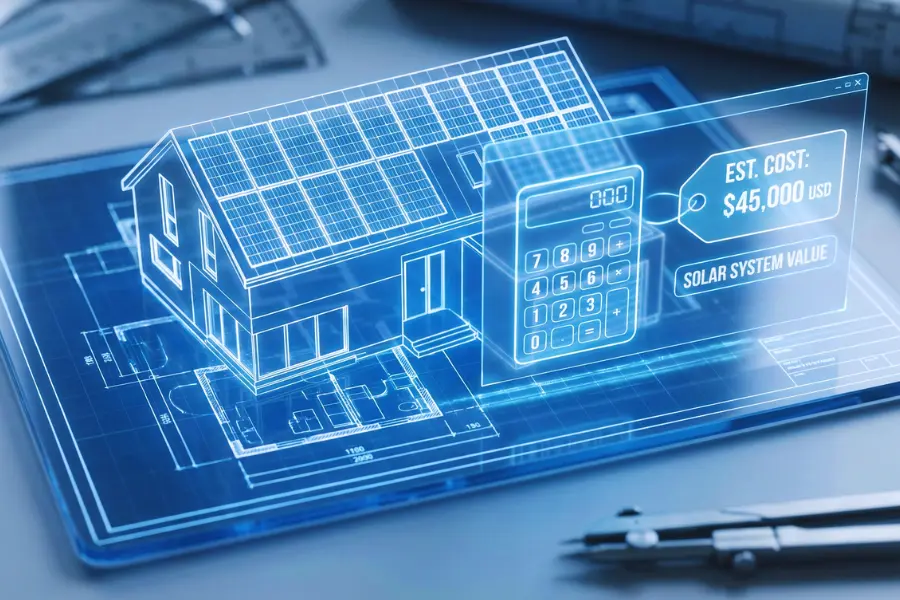
One of the most persistent myths in the renewable energy sector is that solar power remains an unaffordable luxury for the average American household. While this may have been true in 2010, the landscape of 2026 tells a completely different story. With supply chains normalizing and manufacturing efficiency hitting all-time highs, the “soft costs” of solar are finally beginning to compress.
For the average 2,500-square-foot home in the United States, a 10-kilowatt (kW) system is the industry standard. This system size is typically sufficient to offset a monthly electricity bill ranging from $200 to $300. But what is the fair market price for this hardware? And more importantly, how much of that price is actual equipment versus installer profit?
The “Price Per Watt” Metric Explained
To understand solar pricing, you must think in terms of Price Per Watt (PPW). This is the universal metric used to compare quotes, similar to “price per square foot” in real estate. In Q1 2026, the national average cash price for residential solar has settled between $2.60 and $3.10 per watt before incentives.
🔥 Great Deal: Under $2.70/watt. (Often found with local, smaller installers).
✅ Fair Market Value: $2.80 – $3.00/watt. (Standard for reputable regional companies).
❌ Overpriced: Over $3.50/watt. (Unless premium batteries or main panel upgrades are included, this is likely a quote with hidden fees).
State-by-State Cost Breakdown (10kW System)
Geography plays a massive role in pricing. Labor rates, local permitting fees, and state-specific incentives create significant price variance. Below is the 2026 data for the top solar markets:
| State | Avg. Cash Price | Net Cost (After 30% ITC) | Avg. Payback |
|---|---|---|---|
| California | $29,500 | $20,650 | 5.2 Years |
| Texas | $26,800 | $18,760 | 9.1 Years |
| Florida | $27,200 | $19,040 | 8.5 Years |
| New York | $31,000 | $21,700 | 6.4 Years |
| National Avg. | $28,600 | $20,020 | 7.8 Years |
Where Does Your Money Go? The Hard Truth
Many homeowners are shocked to learn that the solar panels themselves—the shiny glass rectangles on the roof—account for less than 40% of the total check they write. The majority of the cost lies in “Soft Costs.”
1. Hardware (45%)
This includes the photovoltaic modules (panels), the inverter (which converts DC to AC power), racking, and wiring. In 2026, premium panels from brands like REC, Qcells, or Maxeon cost roughly $0.60 per watt wholesale.
2. Labor & Installation (20%)
Solar is construction work. It requires licensed electricians and roofers working in dangerous conditions. Labor costs have risen slightly due to wage inflation, but installation speeds have improved.
3. Customer Acquisition & Overhead (35%)
This is the “fat” in the industry. Marketing, sales commissions, office rent, and insurance make up a huge chunk of your quote. This is why “door-to-door” solar quotes are often higher—that salesperson’s commission is built into your price per watt.
Hidden Costs You Might Not Expect
When budgeting for your 10kW system, be aware of these potential “add-ons” that basic online calculators might miss:
- Main Panel Upgrade (MPU): If your home was built before 1990, your electrical panel might only be 100 Amps. Solar often requires 200 Amps. An upgrade costs between $2,500 and $4,000.
- Tile Roof Adders: Installing on Spanish clay tile is more difficult and risky than asphalt shingles. Installers often charge an extra $0.10/watt (approx. $1,000) for tile roofs.
- Critter Guards: If you live in a wooded area, squirrels love to chew solar wires. A mesh guard around the array costs about $500 – $800 and is highly recommended.
Disclaimer: Market Fluctuations
The prices listed above are estimates based on Q1 2026 market data. Actual quotes will vary based on your specific roof complexity, shading, and local jurisdiction fees. CalcMySolar does not sell solar equipment and these figures are for educational budgeting purposes only.