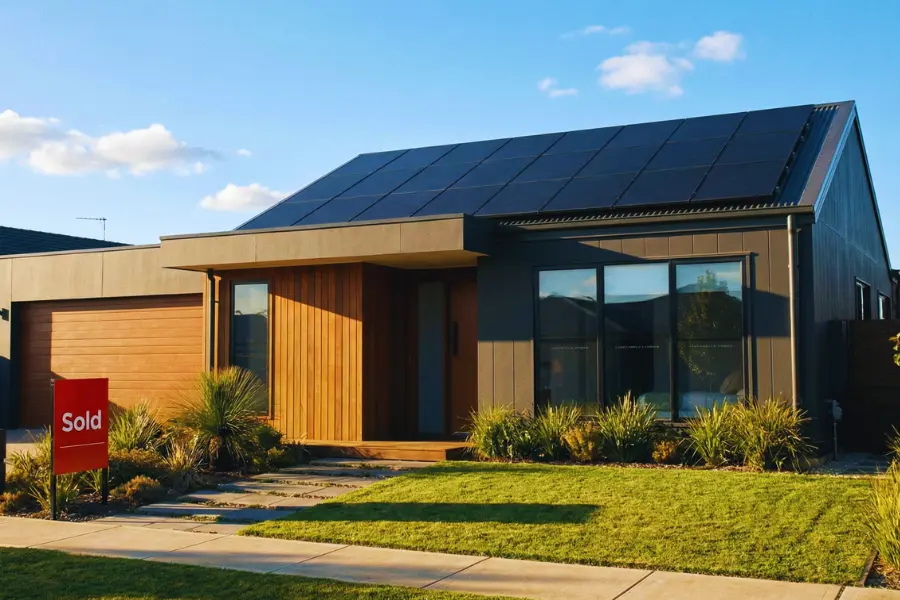
For most Americans, their home is their largest financial asset. Any major renovation, whether it’s a new kitchen or a solar energy system, is scrutinized through the lens of Return on Investment (ROI). The question is simple: “If I spend $20,000 on solar today, will I get that money back when I sell my house?”
The short answer is yes—but with one major caveat. In 2026, the real estate market has fully embraced energy efficiency. Buyers are more conscious of utility costs than ever before, and a home with a guaranteed low electric bill is a hot commodity.
The Zillow Premium: 4.1% Increase
with Owned Solar Panels
According to comprehensive data analysis by Zillow and the National Renewable Energy Laboratory (NREL), homes with solar panels sell for an average of 4.1% more than comparable homes without them.
This means that in many cases, the increase in home equity covers nearly the entire cost of the system (after the tax credit is applied). Essentially, you get to enjoy free electricity for years, and then recoup your initial investment upon sale.
Location Matters: The “Green” States
The premium isn’t uniform across the country. In states with high electricity rates and eco-conscious buyers, the value add is significantly higher:
- New York / New Jersey: Premium can reach 5.4%.
- California: Premium averages 3.5% – 4.5% (due to solar being standard on new builds).
- Florida / Texas: Premium averages 3.8% – 4.0%.
The “Ownership” Caveat (Very Important)
Appraising a Solar Home
If you own your system, ensure your appraiser is “Green Certified” by the Appraisal Institute. They are trained to quantify the value of energy savings using the “Income Approach”—calculating the present value of 20 years of avoided utility bills.
Selling Speed
Beyond price, there is the factor of time. Data from Redfin suggests that energy-efficient homes spend less time on the market. In a competitive environment, a pre-paid electric bill is a massive differentiator against a neighbor’s house that comes with a $300/month liability.
Disclaimer
Real estate markets are hyper-local. The figures cited above are national and regional averages. We recommend consulting with a local real estate agent to understand how solar is valued in your specific neighborhood.